CIQTEK EPR
Centro de productos

Productos

Ciencia y tecnología cuánticas
La tecnología cuántica pertenece al campo de innovación científica y tecnológica de frontera estratégica y fundamental, que puede superar el cuello de botella de la tecnología clásica aumentando la velocidad de la computación, mejorando la precisión de las mediciones y garantizando la seguridad de la información.
Ciencia de los Materiales
Utilizando instrumentos analíticos avanzados, estudie la interrelación entre el proceso de preparación o procesamiento de materiales, la microestructura de los materiales y las propiedades macroscópicas de los materiales.
quimicos
quimicos
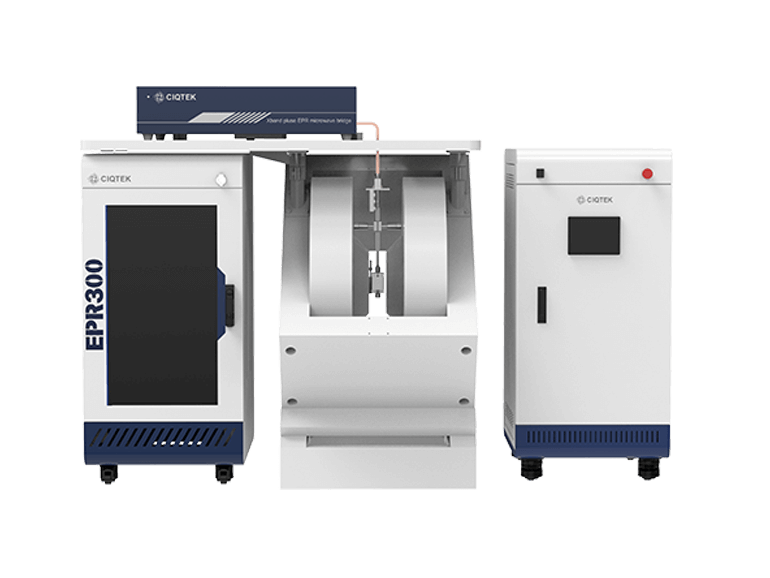
Se analizan la estructura de sustancias que contienen electrones desapareados (como átomos individuales aislados, conductores, moléculas magnéticas, iones de metales de transición, iones de tierras raras, grupos de iones, materiales dopados, materiales defectuosos, radicales biológicos, metaloproteínas, etc.) y sus aplicaciones. Realizado mediante espectroscopía de ondas.
Ciencias industriales y aplicadas
Proporcionar productos y soluciones de alta calidad y alto nivel para usuarios industriales e investigación científica aplicada basada en tecnología avanzada y productos confiables.
Potencia energética
Potencia energética
Centrarse en la utilización de recursos de petróleo y gas no convencionales, como el petróleo y el gas de esquisto, el metano de yacimientos de carbón, el hielo combustible, etc., y desarrollar escenarios de aplicación como la detección cuántica de fondo de pozo y el análisis de núcleos digitales.
Biomédica y ciencias biológicas
Se aplica para resolver la estructura y función de macromoléculas biológicas, imágenes de una sola molécula, imágenes subcelulares, clasificación de células y otros campos, la escala de medición abarca desde el nanómetro hasta la escala de micras.

Sobre CIQTEK

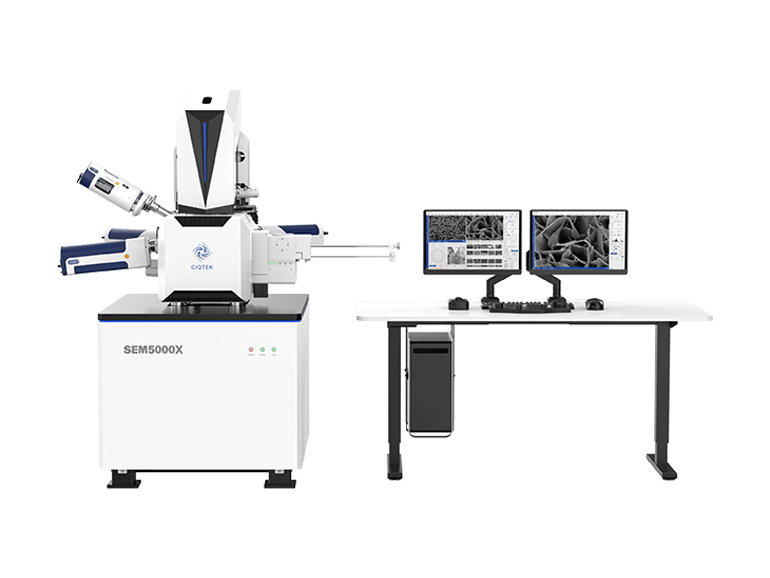
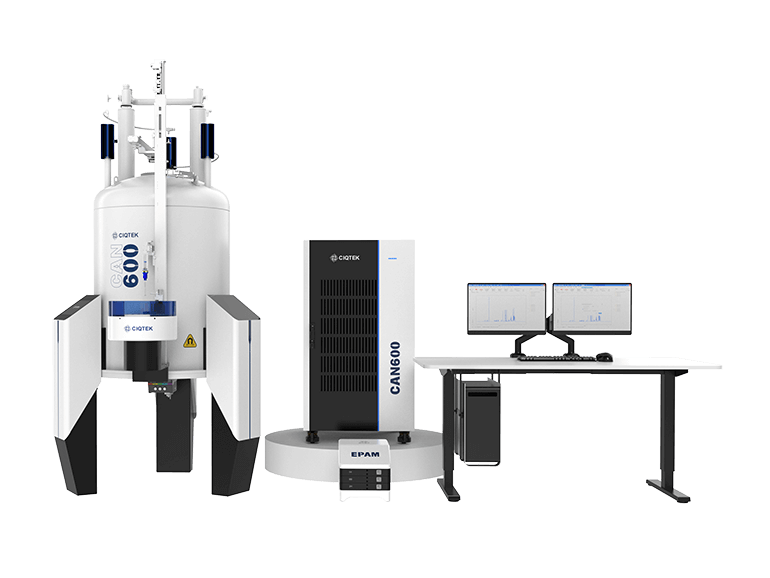
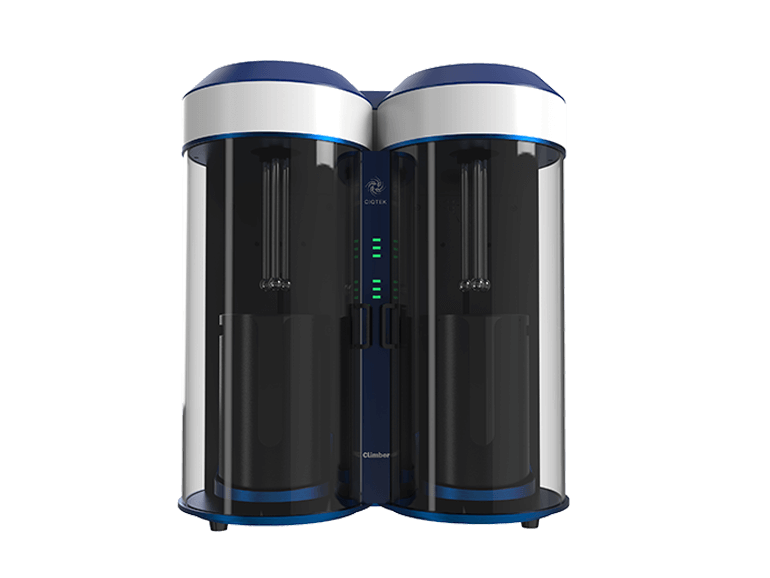
CIQTEK es un desarrollador y fabricante global de instrumentos científicos de alto valor. Nuestras principales líneas de negocio incluyen microscopios electrónicos (SEM/FIB, TEM), espectrómetros de resonancia magnética nuclear (RMN), espectrómetros de resonancia paramagnética electrónica (resonancia de espín electrónico) y analizadores de superficie y poros BET.
  • 0+
    Empleados
  • 0% +
    Empleados dedicados a I+D
  • 0+
    Patentes pendientes u concedidas
Noticias y eventos

Noticias

Qué hay de nuevo
CIQTEK SEM Reveals δ-Precipitation Strengthening in SLM CoCrNiNb0.12 Alloy
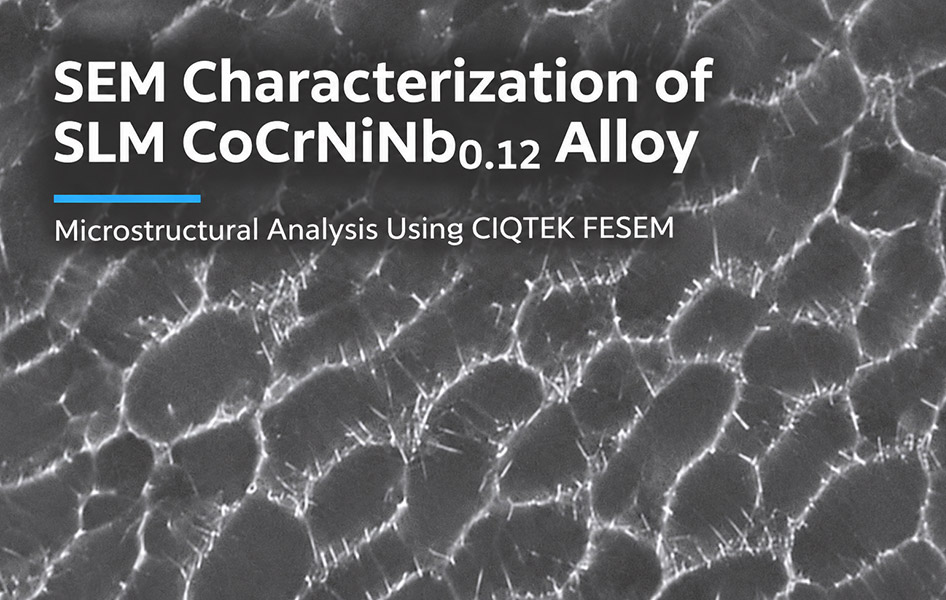
How can a laser-additively manufactured alloy achieve higher strength without completely sacrificing ductility, even at cryogenic temperature? A recent study investigated this question using a Nb-added CoCrNiNb0.12 multi-principal element alloy produced by selective laser melting, or SLM, followed by heat treatment. The study was published in Materials Science & Engineering A under the title “Strengthening and deformation mechanisms of selective laser melted CoCrNiNb0.12 multi-principal element alloy by constructing δ nano-precipitate and stable cellular structure.” Researchers at Beihang University investigated the alloy using a combination of microstructural and mechanical characterization methods. A CIQTEK FESEM 4000X field-emission scanning electron microscope operating in backscattered electron, or BSE, mode was used to observe the microstructural characteristics. The study shows that a stable Nb-rich cellular structure, together with nanoscale δ precipitates formed after annealing, provides an effective route to strengthening the alloy from room temperature down to 77 K. Figure 1. Study of SLM CoCrNiNb0.12 Alloy Using CIQTEK FESEM 4000X Why Strengthen CoCrNi-Based Alloys? CoCrNi multi-principal element alloys feature a face-centered cubic, or FCC, solid-solution matrix and show strong mechanical performance at low temperatures. However, insufficient yield strength can limit their use in engineering applications. At the same time, increasing strength while retaining useful ductility remains an important challenge, especially under cryogenic conditions. In this work, the researchers combined selective laser melting with Nb alloying and subsequent annealing to regulate the cellular microstructure and precipitation behavior of CoCrNiNb0.12. As-Deposited Microstructure: Stable Nb-Rich Cellular Networks Rapid solidification during SLM produced fine grains with an average size of approximately 33 μm. Inside the grains, a clear cellular structure with a characteristic size of approximately 0.44 μm was observed. Strong Nb segregation was found along the cellular boundaries, together with irregular Nb-rich precipitates. Selected-area electron diffraction identified these block-like Nb-rich precipitates as a hexagonal C14 Laves phase. A large number of dislocations were also distributed within the cells and along the cellular boundaries. The Nb-enriched cellular network, precipitates, and associated dislocation structures provided important initial strengthening in the as-deposited alloy. Figure 2. Microstructure and Element Distribution of the As-Deposited CoCrNiNb0.12 Alloy Annealing Promotes δ Nano-Precipitation The alloy was then annealed at 750°C for 10 hours. This condition is referred to as TM-750. After annealing, the average grain size increased only slightly to approximately 36 μm, with no obvious recrystallization. The cellular structure remained clearly visible, with a characteristic size of a...
November 18, 2026
CIQTEK Unveils CryoHe Probe and High-Field Solid-State NMR Systems
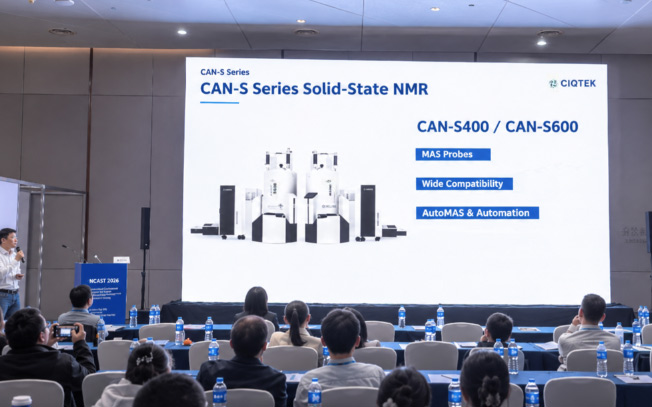
CIQTEK has expanded its NMR portfolio with two new developments: the CryoHe Series helium cryogenic NMR probe and the CAN-S400 and CAN-S600 high-field solid-state NMR spectrometers. Unveiled on October 31 during the 2nd Conference on Analytical Science and Instrumentation (NCASI 2026) in Wuhan, China, the new products address two important needs in NMR research: higher sensitivity for challenging liquid-state samples and high-field structural characterization of solid materials. Figure 1. Launch of the CIQTEK CryoHe Probe and CAN-S Solid-State NMR Systems CryoHe: Higher Sensitivity at Cryogenic Temperature In NMR spectroscopy, sensitivity can determine whether weak signals are detected at all, especially when working with low-concentration, low-abundance, or compositionally complex samples. The CIQTEK CryoHe Series helium cryogenic probe uses closed-cycle deep cryogenic cooling to stabilize the core RF coil at around 20 K. Compared with a conventional room-temperature probe, the CryoHe probe can typically improve the signal-to-noise ratio by around 2× or more for nuclei such as ¹H and ¹³C. When the same signal-to-noise level is required, this can shorten measurement time by roughly an order of magnitude. The probe supports ¹H, ¹³C, ¹⁵N, ³¹P, and ¹⁹F, together with automatic tuning and matching. A low-temperature ²H preamplifier is used to improve lock signal quality and magnetic-field stability. These capabilities are particularly useful in areas such as structural biology, drug research, metabolomics, and natural product analysis, where samples may be limited in quantity or difficult to characterize using conventional sensitivity levels. Figure 2. CIQTEK CryoHe Cryogenic Probe with a 600 MHz Liquid-State NMR System CAN-S400 and CAN-S600 for High-Field Solid-State NMR CIQTEK also introduced the CAN-S400 and CAN-S600 high-field solid-state NMR spectrometers, extending the CAN platform into solid-state NMR applications. Solid-state NMR enables researchers to study the chemical environment and molecular dynamics of insoluble or poorly soluble solid materials while preserving their structure. The CAN-S Series uses a distributed spectrometer architecture and high-uniformity, high-stability superconducting magnets, with 9.4 T and 14.1 T configurations currently supported. Multiple rotor sizes are available, including 3.2 mm, 4 mm, and 7 mm. The 3.2 mm rotor supports spinning speeds of up to 24 kHz. The system supports automatic magic-angle calibration, probe tuning and matching, as well as MAS speed setting and monitoring, rotation stability control, gas-path status monitoring, and abnormal-condition protection. At the hardware level, the CAN-S platform uses an integrated architecture that also supports liquid-state NMR workflows, allowing more efficient switching between solid-state and liquid-state measurements within the broader CAN platform.   Expanding the CIQTEK NMR Platform The si...
November 13, 2026
From Imaging to Reports: CIQTEK Launches SEM Agent
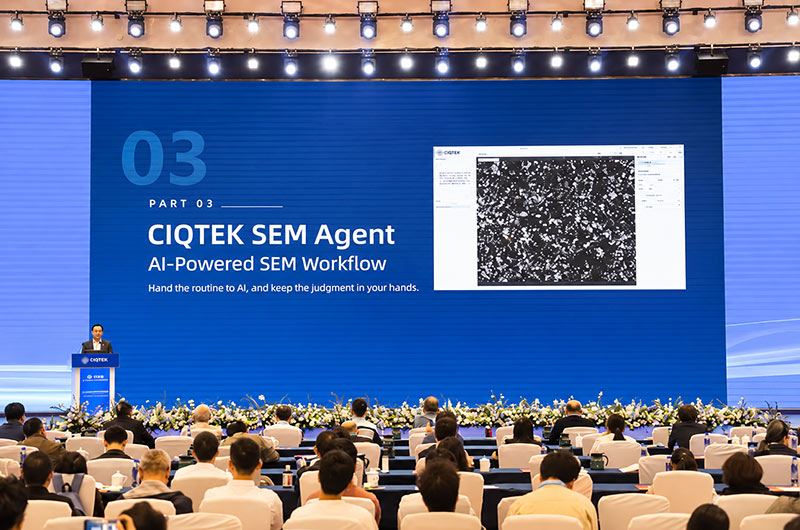
What if you could simply tell your SEM what you need, then let it handle the repetitive work? CIQTEK has launched SEM Agent, an AI-assisted platform designed to connect SEM imaging, analysis, and reporting in one workflow. Users can describe a task by text or voice, and the system can call more than 40 tools to carry out steps from area selection and image acquisition to data analysis and report generation. The idea is simple: reduce the time spent adjusting settings, searching for areas of interest, moving data between software, and organizing reports, while keeping the researcher in control of the final scientific judgment. Figure 1. CIQTEK SEM Agent Unveiled at the 2026 Electron Microscopy Conference Why SEM Workflows Need More Than Better Hardware A powerful microscope does not automatically mean a more efficient workflow. In everyday SEM work, researchers may still spend a large amount of time adjusting parameters, locating samples, organizing images, moving results between different software tools, and preparing reports. Many successful methods also remain tied to individual experience. When a new sample or task appears, the workflow often has to be rebuilt or adjusted manually. SEM Agent is designed to connect the microscope, analysis tools, and workflow knowledge around the task the user actually wants to complete. One Request, One Connected SEM Workflow Instead of operating each step separately, users can describe the task they want to complete. For example, a user can ask SEM Agent to image a lithium iron phosphate sample from 2,000× to 100,000× magnification, organize the images, analyze the results, and prepare a sample report. The system can then check microscope status and imaging conditions, adjust brightness, focus and stigmation, switch between magnifications, collect images, evaluate image quality, analyze sample features, save the results, and organize them into a report. Figure 2. Automated Multi-Magnification Imaging of a Lithium Iron Phosphate Sample Large-area acquisition is another typical task. In one chip demonstration, SEM Agent collected 70 fields of view in a 7 × 10 grid at 1,000× magnification and stitched the images into a larger overview. Each local image remained traceable to its original position. This helps reduce repetitive stage movement and the time normally spent sorting and organizing images after acquisition. Figure 3. Large-Area Automated Acquisition and Image Stitching Image Analysis Built Around the Sample SEM Agent is not limited to image acquisition. Users can also describe what they want to measure or identify, and the system can organize the corresponding analysis workflow. Current applications include particle size analysis, diamond wire measurement, nickel layer inspection, and defect analysis. Depending on the task, the workflow can include segmentation, measurement, statistics, and visualization. The goal is to reduce repetitive manual tracing, counting, and result organi...
November 02, 2026
Conferencias y Exposiciones
CONTÁCTENOS

Contacto

Arriba

Dejar un mensaje

Dejar un mensaje
¡No dude en contactarnos para obtener más detalles, solicitar una cotización o reservar una demostración en línea! Le responderemos tan pronto como podamos.
Entregar

Hogar

Productos

Charlar

contacto